
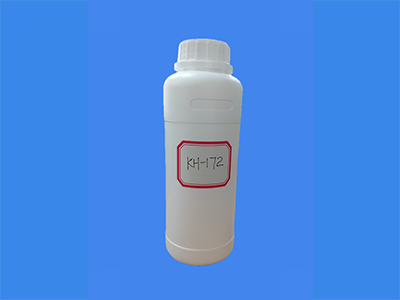
Solid KH-172
Chemical name: Vinyl tri(2-methoxyethoxy)silicane
CAS: 1067-53-4
Content: 60%
Package: 25kg per bag
Contact us
- No.420 Zhonghua Road,Qinghuai District, Nanjing,China 210001
- 008618005174481
- Mr.Sam
- sales@nanjingchem.com

Product Introduction
Solid KH-172 Introduction |
| CAS number 1067-53-4 corresponds to the compound vinyltris (2-methoxyethoxy) silane, also commonly known as silane coupling agent KH-172 or ZQ-172. It is a bifunctional molecule with a molecular structure consisting of one vinyl functional group and three hydrolyzable alkoxy groups (2-methoxyethoxy). The molecular formula is C11H24O6Si and the molecular weight is 280.39. The core use of this compound is as a silane coupling agent, enhancing the bonding between inorganic materials and organic polymers through bidirectional chemical reactions. |
Solid KH-172 specific applications |
| It is mainly used as an adhesion promoter for various mineral filled polymers (such as aluminum hydroxide, magnesium hydroxide, kaolin, silica) to improve the mechanical and electrical properties of composite materials, especially in humid environments where the effect is more significant; As a crosslinking agent in polymer material modification, such as for the modification of ethylene propylene diene monomer (EPDM) to enhance the properties of elastomers, and to promote crosslinking reactions in silane crosslinked cable materials; It is used as a glass fiber treatment agent to improve the interfacial adhesion between fibers and resin matrix, and used to manufacture hydrophobic agents to improve the surface hydrophobicity of fillers, thereby enhancing compatibility and processing flowability. |
Latest research on KH-172 |
| There have been no recent public reports of new research or significant scientific discoveries regarding this compound. The existing information is mainly based on its mature industrial applications, emphasizing its stable performance in cable insulation materials, composite materials, coatings and other fields, such as improving wet mechanical strength and water resistance; Due to its relatively stable chemical properties, recent updates have mainly focused on industrial use descriptions and safety data (such as protective measures), rather than breakthroughs in basic research. |
